How to use AI without breaking the GDPR
There is no “GDPR-safe” AI vendor you can buy your way to compliance with — under the GDPR, you are the controller, and the responsibility is yours. The good news: one control removes most of the problem at once — don’t send the personal data in the first place. This is general guidance, not legal advice.
Is it even legal to put personal data into ChatGPT under the GDPR?
In principle, yes — but pasting personal data into an AI tool is a disclosure to another party, and that is real processing under the GDPR, not a private scratchpad. To do it lawfully you have to clear five hurdles: a lawful basis, data minimisation, a valid transfer mechanism, an extra condition for special-category data, and a DPIA where the risk is high. Each is covered below. The pattern that makes all of them easier is the same one regulators point to first: minimise.
1. You need a lawful basis before the data leaves your building (Art. 6)
Every processing of personal data needs at least one of the six lawful bases in Article 6. For feeding data into a commercial AI tool the realistic candidates are consent, contract or legitimate interests — and legitimate interests only holds where your interest isn’t overridden by the individual’s rights, which the EDPB frames as a three-step test. The trap to avoid: a signed contract with the AI vendor is not a lawful basis. You, the controller, must establish one independently before the data ever leaves your environment.
2. Data minimisation is the principle regulators actually expect (Art. 5)
Article 5(1)(c) requires personal data to be “adequate, relevant and limited to what is necessary,” and Article 5(2) makes you accountable for proving it. In practice that means only exposing what the task genuinely needs — and if a summary or a draft can be produced from placeholders instead of real names, then the real names weren’t necessary. This is the legal hook for stripping identifiers before they reach an AI tool: not a loophole, just the principle applied.
3. A DPA with the AI vendor is necessary — but not sufficient
When a provider processes personal data on your behalf, you need a data-processing agreement under Article 28. But a DPA only governs how the processor handles data — it doesn’t supply your lawful basis, run your DPIA, or clear your transfer. And it only exists on business tiers: OpenAI offers an Art. 28 addendum and SCCs on the API, ChatGPT Business and Enterprise, while ordinary consumer ChatGPT (Free/Plus) has no DPA at all. (Source: OpenAI.) The EDPB has also signalled that a downstream agreement can’t cure an upstream lawful-basis failure.
4. Sending prompts to a US AI tool is an international transfer (Chapter V)
When your prompt goes to a US-based provider, that’s an international transfer governed by Chapter V. After Schrems II struck down Privacy Shield, transfers now rely on the EU-US Data Privacy Framework or on Standard Contractual Clauses plus a transfer impact assessment. The Framework was upheld by the EU General Court in 2025 but remains under appeal — the same kind of legal uncertainty that ended the previous two arrangements. Minimising the personal data you send neutralises the transfer question entirely: no personal data, no transfer to justify.
5. Special-category data is where AI use gets hardest (Art. 9)
Health, biometric, political, religious, trade-union and sexual-orientation data are special-category data, and processing them needs an Article 9 condition on top of your Article 6 basis — usually explicit consent. Feeding this into a chatbot is high-risk by default, so the safest posture is to strip or pseudonymise it before input.
When you need a DPIA (Art. 35)
A Data Protection Impact Assessment is mandatory when processing is “likely to result in a high risk” — large-scale special-category data, or systematic profiling with legal or similarly significant effects. Many enterprise AI deployments meet a trigger. Skipping a required DPIA sits in the lower fine tier: up to €10 million or 2% of global turnover.
Training and retention you don’t control
On consumer ChatGPT (Free and Plus), your conversations are used to train OpenAI’s models by default unless you turn off “Improve the model for everyone,” and a 2025 US court order required OpenAI to preserve logs — including chats users had deleted. Once data is on a vendor’s servers, “delete” is a request, not a guarantee. We cover this in depth in does ChatGPT save your data?
What regulators are actually doing
This isn’t theoretical. In December 2024, Italy’s Garante fined OpenAI €15 million for training ChatGPT on personal data without an adequate lawful basis, transparency shortfalls, an unnotified breach and no age verification. (Source: Euronews.) At EU level, the EDPB’s Opinion 28/2024 set a deliberately high bar for when an AI model counts as “anonymous.” Meanwhile most workplace AI use still runs through personal accounts with none of the business-tier safeguards — which is exactly where the exposure builds.
A GDPR-compliant AI workflow
A repeatable sequence you can document for accountability, each step anchored to an Article:
- Map the personal data. Before you prompt, know what personal data the task actually involves — names, contact details, IDs, financial or health data — and whether any of it is special-category (Art. 9).
- Establish a lawful basis (Art. 6). Pick and document a basis for the disclosure to the AI provider — usually consent, contract or legitimate interests. A vendor contract is not itself a lawful basis; you, the controller, must have one.
- Minimise before input (Art. 5(1)(c)). Strip or pseudonymise everything the task doesn’t need. This is the single step that removes most of the risk — if no personal data reaches the tool, most of the other hurdles shrink. A local tool like Occlira does this across documents, spreadsheets, email, audio and images in one pass.
- Use a business tier with a DPA. If personal data must go in, prefer a tier that offers an Art. 28 data-processing agreement and Standard Contractual Clauses (the API, ChatGPT Business/Enterprise) over a consumer account — and turn off model training.
- Handle the transfer (Chapter V). Sending prompts to a US provider is an international transfer. Rely on the EU-US Data Privacy Framework or SCCs plus a transfer assessment — or sidestep it by not sending personal data at all.
- Run a DPIA if triggered (Art. 35). Large-scale special-category processing or systematic profiling with significant effects generally needs a Data Protection Impact Assessment before you start.
- Log it, then restore locally (Art. 5(2)). Record your basis, minimisation and DPIA to meet the accountability duty. Do the AI work on the anonymised copy, then restore the real values on your own machine.
How Occlira fits — the minimisation step
Occlira operationalises step 3. It detects and removes 38 types of PII — names, national IDs, emails, financial and health data and more — across documents, spreadsheets, email, audio and images, 100% on your own computer, with no cloud and no account. Nothing reaches a US server, there’s nothing to feed model training, and nothing for a court order to preserve — because the personal data never leaves your device.
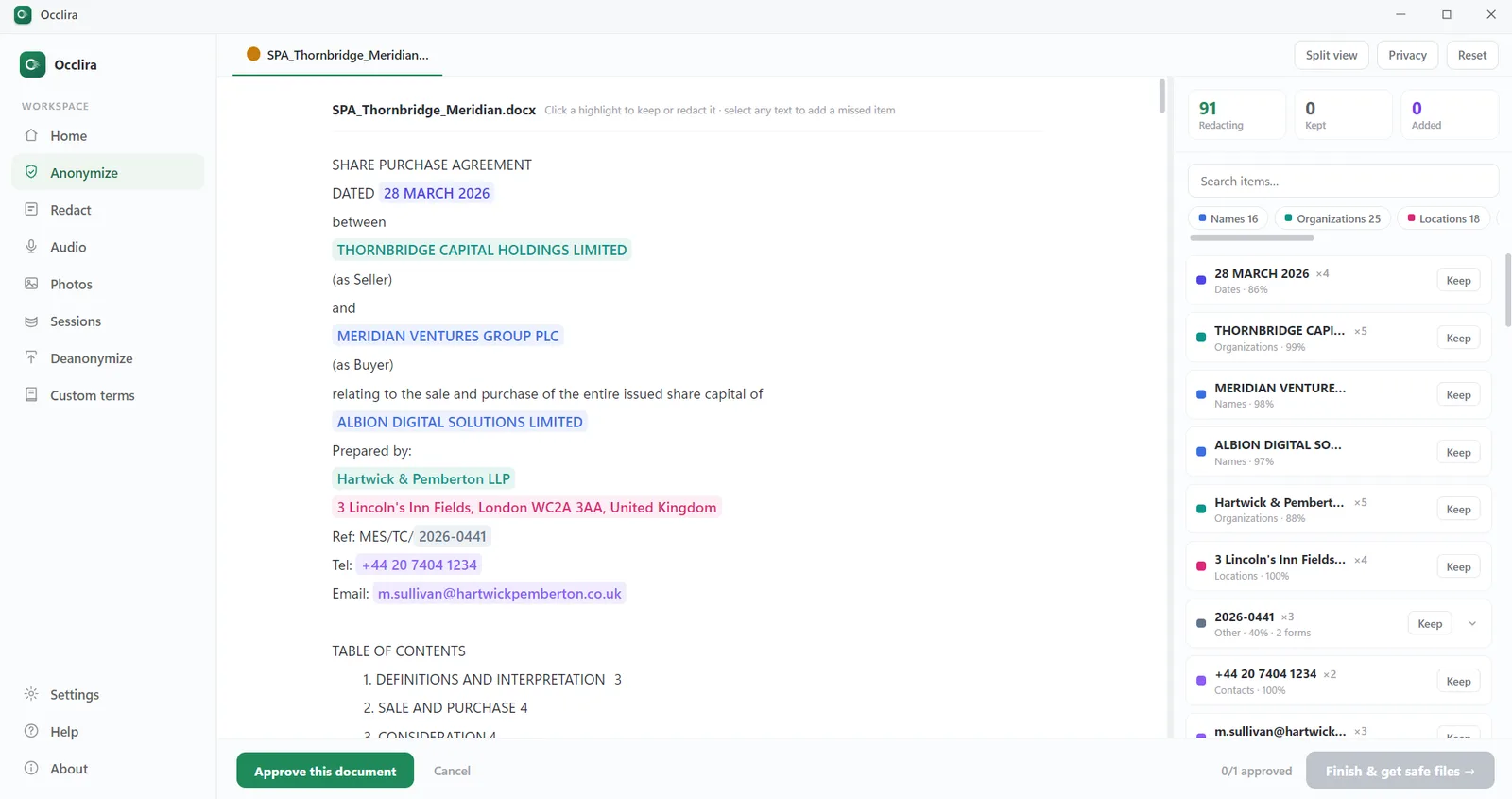
One honest caveat, because it matters: Occlira’s anonymisation is reversible — it swaps each identifier for a placeholder and keeps the mapping on your device. In GDPR terms that is pseudonymisation, and pseudonymised data is still personal data (Recital 26). So treat it as strong data minimisation that keeps your processing minimal and under your control — not as a way to take the data out of GDPR scope. See exactly what stays on your device on the Data & Privacy Practices page, and anonymize text before ChatGPT for the step-by-step mechanics.
Frequently asked questions
In principle yes, but only if you clear several hurdles: a lawful basis (Art. 6), data minimisation (Art. 5(1)(c)), a valid mechanism for the transfer to a US provider (Chapter V), an extra condition for any special-category data (Art. 9), and a DPIA where the processing is high-risk (Art. 35). Pasting personal data into an AI tool is a disclosure to another party, so it is real processing — not a private note. The reliable shortcut is to not send the personal data at all.
You need one of the six Art. 6 bases before the data leaves your environment. For AI use the realistic candidates are consent, contract or legitimate interests; legitimate interests requires a balancing test that your interest doesn’t override the person’s rights. Crucially, a contract with the AI vendor is not a lawful basis — you must establish your own.
No. A data-processing agreement (Art. 28) is necessary when a provider processes personal data for you, but it doesn’t supply your lawful basis, handle your transfer assessment, or run your DPIA. It also only exists on business tiers — ordinary consumer ChatGPT (Free/Plus) has no DPA at all. And the EDPB has signalled that a downstream agreement can’t cure an upstream lawful-basis failure.
Yes. Data going to a US-based provider is a transfer under Chapter V and needs a valid mechanism — currently the EU-US Data Privacy Framework or Standard Contractual Clauses with a transfer assessment. Because that framework is being challenged in court, as its predecessors were, minimising what you send is the most durable way to de-risk the question.
When the processing is “likely to result in a high risk” — for example large-scale use of special-category data, or systematic profiling with legal or similarly significant effects. Many enterprise AI deployments meet a trigger. Skipping a required DPIA sits in the lower fine tier (up to €10M or 2% of global turnover).
Only with an Art. 9 condition on top of your Art. 6 basis — usually explicit consent — and it’s high-risk processing. Health, biometric, political, religious and sexual-orientation data all qualify. The safest posture by far is to strip or pseudonymise it before it ever reaches the tool.
Pseudonymised data — reversible with information kept separately — is still personal data (Recital 26). Only truly anonymous data falls outside the GDPR, and the bar is high. So replacing identifiers with reversible placeholders is strong data minimisation, not an exit from the rules.
Yes. In December 2024 Italy’s Garante fined OpenAI €15 million, finding it had trained ChatGPT on personal data without an adequate lawful basis, fell short on transparency, failed to notify a 2023 breach and lacked age verification. It’s a concrete sign regulators act on lawful-basis and transparency failures, not just guidance.
You (or your organisation) are the controller for the personal data you choose to put in — you decide the purpose and means. The AI provider is a processor only under a business agreement; on a consumer account there is no such arrangement, which leaves you carrying the full controller responsibility with none of the Art. 28 safeguards.
Minimise personal data before AI sees it
Remove the identifiers locally, use any AI tool on the copy, restore on your machine. Free for 14 days on Windows and macOS.
More: for law firms · is ChatGPT HIPAA compliant? · local vs cloud redaction · how your data is handled