AI and client confidentiality for accountants & consultants
Accountants handle some of the most regulated data there is — SSNs, tax IDs, salaries, bank details. You can still get AI’s help on it, safely: anonymize the client identifiers on your own computer first, run the AI on the placeholder version, and restore the real figures locally. This page is general information, not legal or tax advice.
Your confidentiality duties, in one place
- AICPA Rule 1.700.001 — the Confidential Client Information Rule bars disclosing any confidential client information without the client’s specific consent, and the AICPA’s own Journal of Accountancy advises firms to prohibit sharing confidential client data with generative AI.
- IRC §7216 — a criminal statute: a tax preparer who knowingly or recklessly discloses or uses tax return information without consent faces up to a $1,000 fine and a year in prison. (26 U.S.C. §7216.)
- IRC §6713 — the parallel civil penalty: $250 per unauthorized disclosure, capped at $10,000 a year, with no willfulness requirement. (26 U.S.C. §6713.)
- GDPR — for EU-facing work, a client’s name, tax number, salary and bank details are personal data (Art. 4(1)), and a cloud AI tool is a processor needing a DPA.
Does pasting client data into ChatGPT break §7216?
Very likely. The Treasury regulations define “disclosure” broadly (making tax return information known to any person, in any manner) and “tax return information” as anything furnished in connection with preparing a return. There are no-consent exceptions — but they’re for providers doing return preparation, processing or e-filing, not for a general-purpose consumer chatbot. (Source: The Tax Adviser (AICPA).) So pasting a client’s 1040 data into consumer ChatGPT is a disclosure that generally needs consent — and one wrongful disclosure can draw both the §6713 civil penalty and §7216 criminal exposure at once.
Shadow AI is already in your firm
The exposure isn’t hypothetical. Cyberhaven’s 2025 report found 34.8% of the corporate data employees put into AI tools is now sensitive (up from 10.7% two years earlier), and that most AI tools in use rank as high or critical risk. (Source: Cyberhaven.) Another 2025 report found 68% of employees use personal-account AI and 57% enter sensitive data. (Source: Menlo Security.) Consumer tools carry no DPA, train on inputs by default, and — as the New York Times v. OpenAI logs order showed — “delete” doesn’t guarantee deletion. The fix is to strip the identifiers before anything is pasted — Occlira does it locally, in Excel, CSV and tax files, with nothing uploaded. More in does ChatGPT save your data?
Where Occlira helps
| Task | The anonymize-first move |
|---|---|
| Ask AI about a ledger or trial balance | Swap names, EINs and salaries for placeholders, run the AI on the copy, restore locally. |
| Draft from a tax return (e.g. a 1040) | Remove SSNs, tax IDs and identifiers before anything is pasted. |
| Payroll analysis | Anonymize employee names, SSNs and pay figures first. |
| Redact a bank statement for a third party | Burn a real redaction before you share the file. |
| Outsourcing or offshore prep | Minimize identifiers before the file leaves your office. |
| Sharing statements with a client or auditor | Strip other parties’ personal data from the working copy. |
The anonymize-first workflow
- Open the spreadsheet, tax document, payroll file or statement in Occlira on your own computer.
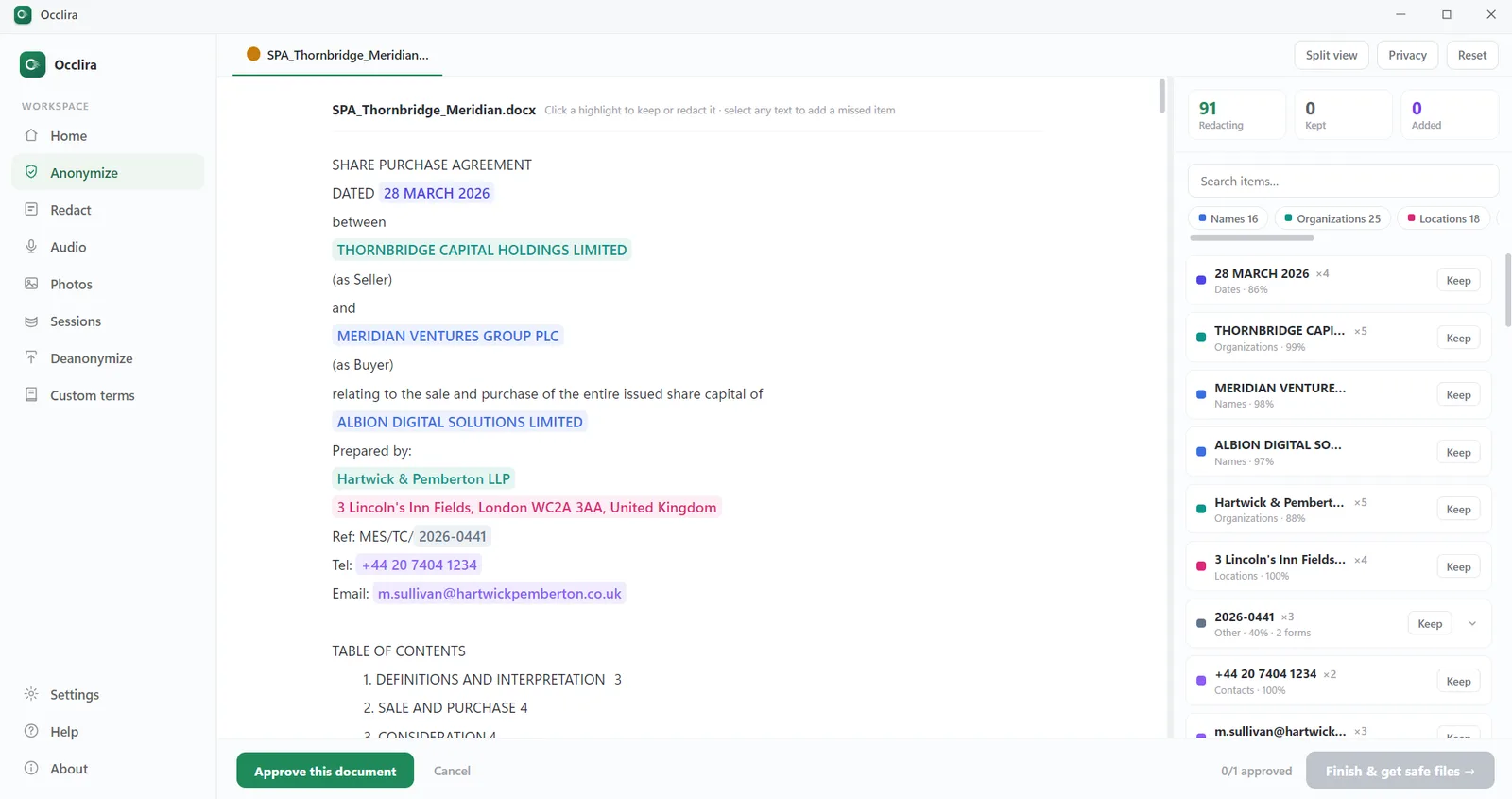
- Review the detected identifiers (names, SSNs/EINs, account numbers, salaries) and confirm what to remove.
- Run any AI tool on the anonymized copy — the placeholders keep the numbers usable.
- Restore the real values locally in your working file, or share a redacted copy for third parties.
How Occlira fits — and what it isn’t
Occlira detects and removes personal data from documents, spreadsheets, email, audio and images entirely on your own computer — no cloud, no account, so there’s no processor created and nothing for a provider to retain. It burns real PDF redactions, and its reversible anonymization keeps the mapping on your device. One honest note: reversible anonymization is pseudonymization, so that mapping is still personal data (kept locally), and Occlira is a tool that helps you meet your confidentiality duties — not a compliance guarantee, and not legal or tax advice. See exactly what stays on your device on the Data & Privacy Practices page.
Frequently asked questions
Not with the raw identifiers. Client names, SSNs, EINs, salaries and account numbers are confidential and — for tax preparers — protected by IRC §7216. You can still use AI, though, by anonymizing the client data locally first and running the AI on the placeholder version.
Yes. Pasting a client’s tax return information into an outside tool is a “disclosure,” and both terms are defined broadly. A general-purpose consumer AI isn’t doing return “preparation, processing or electronic filing,” so it doesn’t fit the narrow no-consent exceptions — meaning you’d generally need the client’s consent, or you avoid it by not sending the identifiers at all.
IRC §7216 is criminal — up to a $1,000 fine and one year in prison per violation (up to $100,000 where it’s identity-theft-related). Separately, §6713 is a civil penalty of $250 per disclosure, capped at $10,000 a year, with no willfulness requirement. A single wrongful disclosure can trigger both.
Generally, yes — unless a narrow §7216 exception applies, and a consumer chatbot doesn’t fit them. The cleaner path most firms take is data minimization: remove the tax return information before it’s sent, so no disclosure occurs.
The Confidential Client Information Rule. It bars a CPA in public practice from disclosing any confidential client information without the client’s specific consent, and it’s broader than §7216 — it covers all non-public client information, not just tax data. The AICPA’s own guidance advises firms to prohibit sharing confidential client data with generative AI tools.
Yes. Article 4(1) defines personal data to include identifiers and factors specific to a person’s economic identity, so a client’s name, tax number, salary and bank details are personal data — and a cloud AI tool processing them is a processor that needs a data-processing agreement.
Open it in Occlira: it detects the names, IDs and financial identifiers in the cells and swaps them for consistent placeholders on your computer, so you can run the AI on the anonymized sheet and restore the real figures locally in your working file.
Yes. Under GDPR Recital 26, if the data can be re-attributed using a mapping you keep, it’s still personal data. Reversible anonymization is strong minimization and local control — not an exit from the rules.
Anonymize client financials before AI sees them
Remove client identifiers locally, then use any AI tool on the copy. Free for 14 days on Windows and macOS.
More: what is PII? · is ChatGPT private? · local vs cloud redaction · how your data is handled